Schema Therapy
Jessica is passionate about supporting families from preconception and beyond
Jessica has immersed herself in the world of Schema Therapy in recent years. Jessica was drawn to learn Schema Therapy as, like EMDR therapy, Schema Therapy aptly views current difficulties and symptoms as understandable coping mechanisms developed earlier in life due to difficult circumstances, events, and unmet needs.
Schema Therapy is an integrative Therapy that incorporates CBT, attachment theory, gestalt therapy, object relations theory, constructivist perspectives, and psychoanalytic thought.
The creators of Schema Therapy, Young et al. (2006) identified 5 broad core emotional needs that we all have, particularly during childhood and adolescence, though also across our lifetime. These include:
Attachment and security (including safety, stability, nurturance, and acceptance)
Opportunities to develop autonomy, competence, and an authentic sense of self
Freedom and support to express and regulate emotions and needs
Spontaneity and play, along with
Healthy limits and boundaries
When these needs go chronically unmet during childhood and adolescence, depending on temperament and other factors, we can tend to develop schemas (e.g., emotional deprivation, self-sacrifice, unrelenting standards) and coping modes or parts (e.g., a critic part, a perfectionist part, a detached part).
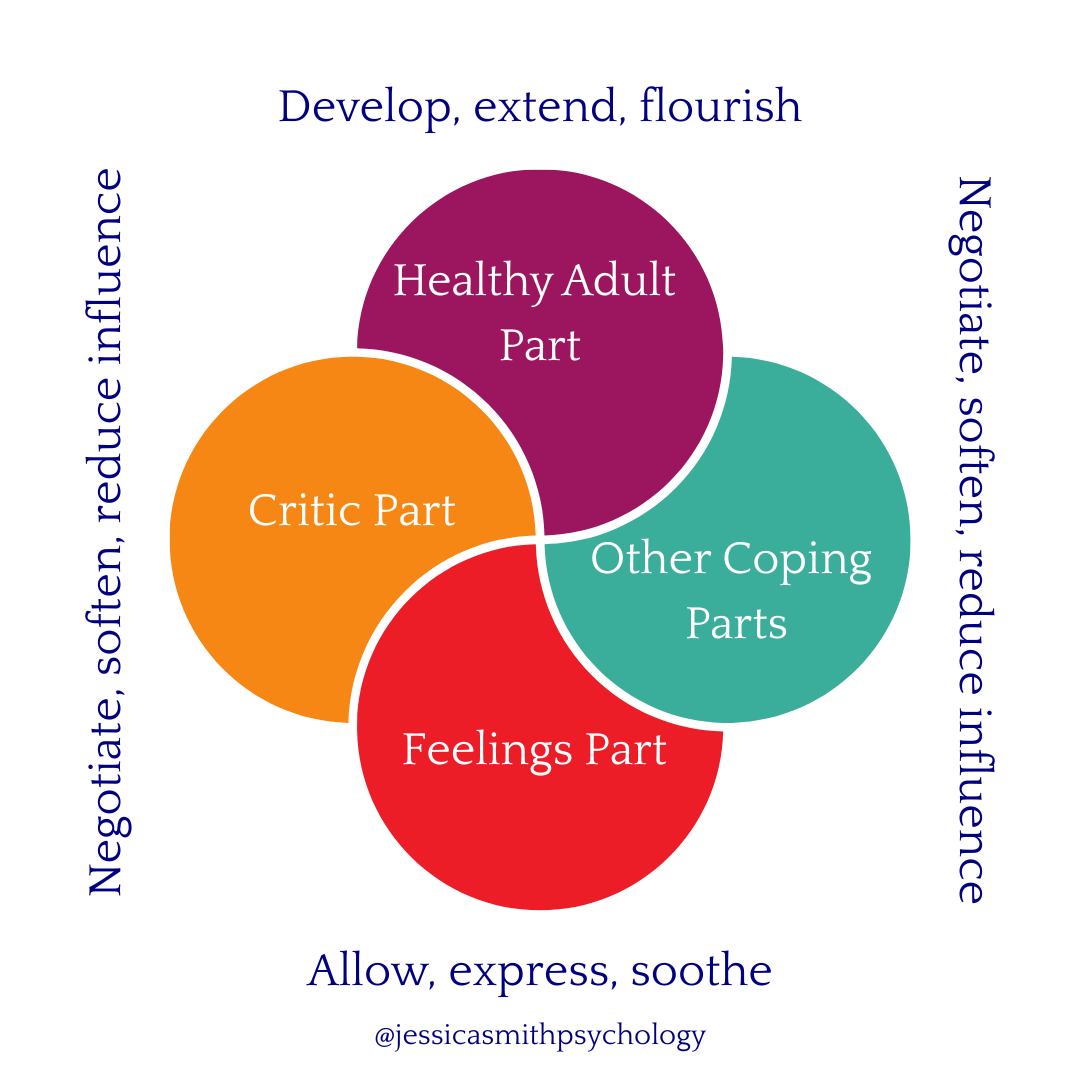
As shown in the image above, Schema Therapy aims to:
Meet ones core emotional needs
Develop and enhance ones Healthy Adult part
Facilitate connection between ones Healthy Adult part and Vulnerable Feeling or Inner Child part/s
Allowing the Vulnerable Feeling or Inner Child part/s to be felt, expressed, and soothed
Identifying, dialoguing, negotiating, softening, limit setting, and reducing the influence of critical and other unhelpful coping modes or parts
Schema Therapy incorporates a range of therapeutic interventions to achieve these aims including:
A strong therapeutic relationship including attunement, limited reparenting, and empathetic confrontation
Cognitive practices (including mindfulness, diaries or journaling, pros/cons lists, flashcards)
Experiential techniques (including chairwork and imagery rescripting), and
Behavioural exercises (including goal setting, roleplaying, behaviour changes, behavioural experiments)
Schema Therapy is another transdiagnostic therapy, and is considered evidence based in the treatment of Depression and Borderline Personality Disorder, with emerging evidence in the treatment of other difficulties including, Anxiety, some Eating Disorders, Complex PTSD, and some addiction difficulties. Schema Therapy can be helpful when you notice big emotional or behavioural responses to everyday stressors that haven’t improved or resolved through awareness, self-help or brief therapy approaches.